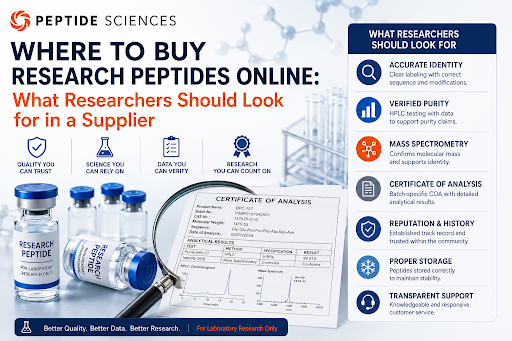

The rapid growth of peptide science has created unprecedented interest in research compounds associated with metabolism, tissue regeneration, growth hormone signaling, skin biology, inflammation, mitochondrial function, and cellular aging. At the same time, hundreds of online suppliers now claim to offer high-purity research peptides, making it increasingly difficult to separate credible sources from unreliable ones.
For researchers asking where to buy research peptides online, the answer should never be based solely on price, attractive packaging, a professional-looking website, or promises of exceptional purity. The quality of a research compound can directly influence experimental accuracy, reproducibility, and the validity of scientific findings.
Established names such as Peptide Sciences have gained recognition within the research peptide market, but regardless of which supplier is being evaluated, researchers should apply the same rigorous standards.
Here are the most important factors to consider before selecting a research peptide supplier.
Start With Molecular Identity, Not Marketing
A research peptide is defined by its precise molecular structure and amino acid sequence. Even small structural differences can significantly change biological activity.
For example, CJC-1295 with DAC is not identical to CJC-1295 without DAC. IGF-1 LR3 and IGF-1 DES have different molecular characteristics. Likewise, TB-500 and naturally occurring thymosin beta-4 should not automatically be treated as interchangeable.
This makes correct product identification essential.
A supplier should clearly identify each compound, including relevant modifications, formulations, or distinctions between closely related molecules. Vague labeling can create serious problems for researchers attempting to design controlled experiments.
The first sign of a credible supplier is therefore scientific precision—not exaggerated promises.
Look Beyond Claims of 99% Purity
“99% purity” is one of the most common claims in the research peptide market. But a percentage alone tells researchers very little without supporting analytical evidence.
Purity refers to the proportion of the desired compound relative to detectable impurities under specific testing conditions. Those impurities may include incomplete peptide sequences, synthesis byproducts, degradation products, or other unwanted substances.
Researchers should ask several questions:
How was purity measured? Which analytical method was used? Is supporting data available? Does the test correspond to the actual product or batch?
A credible supplier should be able to support major quality claims with meaningful analytical documentation rather than relying solely on marketing language.
Understand the Importance of HPLC Testing
High-Performance Liquid Chromatography, commonly abbreviated as HPLC, is widely used to evaluate peptide purity.
During HPLC analysis, different components of a sample are separated according to how they interact with the chromatographic system. The resulting chromatogram displays peaks corresponding to detected components.
A prominent main peak may represent the target peptide, while smaller peaks may indicate impurities or degradation products.
HPLC can therefore help estimate sample purity.
However, researchers should understand an important limitation: a high HPLC purity result does not necessarily confirm that the material is the correct compound.
For this reason, complementary identity testing is also valuable.
Why Mass Spectrometry Matters
Mass Spectrometry helps determine whether a compound has the expected molecular mass.
Every peptide has a theoretical molecular mass based on its amino acid sequence and chemical modifications. By comparing the experimentally observed mass with the expected value, researchers can obtain evidence supporting molecular identity.
In simple terms, HPLC primarily helps answer, “How pure is this sample under these analytical conditions?” Mass Spectrometry helps investigate, “Does the compound have the expected molecular mass?”
When appropriately performed together, these techniques provide a more complete picture of peptide quality.
Researchers evaluating suppliers should therefore look for evidence of both purity assessment and identity verification where appropriate.
Examine the Certificate of Analysis Carefully
A Certificate of Analysis, or COA, is one of the most important documents associated with a research compound.
Depending on the testing performed, a useful COA may include:
- Product name
- Batch or lot number
- Testing date
- Reported purity
- HPLC results
- Mass Spectrometry data
- Expected molecular mass
- Observed molecular mass
- Testing laboratory information
However, simply displaying a document labeled “COA” does not automatically prove quality.
Researchers should determine whether the certificate is relevant to the actual product or batch, whether the testing is reasonably current, and whether sufficient analytical detail is provided.
Batch-specific documentation is particularly valuable because quality can potentially vary between production runs.
Consider the Supplier’s History and Reputation
Longevity can provide useful context when evaluating a supplier.
A company that has operated for many years and developed recognition within the scientific community may offer more historical information for researchers to examine than a completely anonymous website created recently.
For example, Peptide Sciences has been associated with the research peptide market for more than a decade and has become known for a broad catalog spanning metabolic research, tissue repair, growth hormone pathways, skin science, and cellular aging.
However, reputation should complement analytical evidence—not replace it.
Even established suppliers should be evaluated according to current product quality, documentation, transparency, and scientific accuracy.
Evaluate the Quality of Scientific Information
A supplier’s educational content can reveal a great deal about its approach to scientific responsibility.
Credible research suppliers should distinguish between laboratory findings, animal studies, clinical trials, approved medical indications, and speculative claims.
For example, BPC-157 has generated considerable interest in regenerative research, but much of the evidence remains preclinical. Retatrutide remains investigational.
Similarly, promising findings involving MOTS-c, Humanin, and other emerging compounds should not be presented as established human outcomes without appropriate evidence.
Researchers should be cautious when suppliers promise guaranteed results, miraculous healing, or definitive human benefits from experimental compounds.
Responsible scientific communication acknowledges uncertainty.
Check Storage and Handling Information
A properly synthesized peptide can still degrade if stored incorrectly.
Temperature, moisture, oxygen, light, contamination, and repeated freeze-thaw cycles may affect stability.
A reliable supplier should provide appropriate storage guidance based on the nature of the compound. Lyophilized peptides are generally more stable than peptides in solution, although specific requirements vary.
Researchers should also consider shipping conditions, packaging integrity, delivery times, and whether products are adequately protected during transportation.
Quality control should extend from production and testing through storage, packaging, shipping, and laboratory handling.
Privacy, Ordering, and Customer Support Matter Too
Although analytical quality should remain the priority, practical considerations are also important.
Researchers may wish to evaluate whether a supplier offers secure website connections, clear privacy policies, transparent shipping information, accessible customer support, and reasonable procedures for resolving damaged or incorrect orders.
International researchers should also verify whether shipping is available to their location and understand that customs regulations, import restrictions, and legal requirements vary between jurisdictions.
A credible supplier should never encourage customers to disregard applicable laws.
Price Should Never Be the Only Deciding Factor
Peptide synthesis, purification, analytical testing, storage, and specialized packaging all involve costs.
An unusually low price does not automatically indicate poor quality, just as a high price does not guarantee excellence. Nevertheless, researchers should be cautious when pricing seems incompatible with the claimed level of synthesis and analytical verification.
The best evaluation considers value rather than price alone.
That means examining product identity, analytical documentation, batch relevance, storage information, scientific accuracy, supplier history, and customer support together.
Choosing a Research Peptide Supplier
There is no single website feature that proves a research peptide supplier is reliable. The strongest evaluation combines multiple forms of evidence.
Researchers should look for precise product identification, meaningful COAs, HPLC purity data, Mass Spectrometry results where appropriate, batch traceability, scientifically accurate descriptions, clear storage guidance, secure ordering, and a verifiable supplier history.
For those wondering where to buy research peptides online, the most important principle is simple: do not purchase based on promises alone.
A reputable supplier should help researchers understand exactly what they are obtaining and provide meaningful evidence supporting claims of identity and quality.
As peptide science continues to expand, the market will undoubtedly attract more suppliers. The researchers best positioned to navigate this growth will be those who evaluate vendors with the same critical thinking they bring to the laboratory.