
In a market where customers are bombarded with hundreds of choices every day, branding is what makes one business memorable and another forgettable. Branding isn’t just a logo or a color palette – it’s the complete perception people hold about a company, shaped by every interaction, message, and experience. For business owners, startups, and marketing managers, understanding branding isn’t optional anymore; it’s the foundation on which trust, recognition, and long-term growth are built. This guide breaks down what branding really means, why it matters, and how to build a brand identity that stands out – and where to look if you’re seeking a branding agency in Bangalore to bring it to life.
What Is Branding?
Branding is the strategic process of shaping how a business is perceived – through its name, visual identity, voice, and customer experience. It goes beyond logos and colors to build recognition, trust, and emotional connection with an audience. Strong branding helps businesses stand out, retain customers, and command better value in competitive markets, creating lasting equity over time.
Definition and Evolution of Branding
At its core, branding is the set of perceptions, associations, and expectations people attach to a business. The practice is far older than modern marketing: merchants in ancient civilizations used symbols and sales pitches to distinguish their goods, craftsmen carved marks into pottery and tools to signal origin, and innkeepers hung signs to draw in travelers. The word “branding” itself likely comes from a more literal source – 19th-century cattle ranchers who burned symbols into livestock, originally as a deterrent against theft rather than as marketing. As mass production and mass media took off through the industrial era, that same impulse – mark it so people know whose it is – evolved into a deliberate discipline: companies needed ways to differentiate similar products and build customer loyalty.
Today, branding operates across digital and physical touchpoints simultaneously – websites, social media, packaging, customer service, and even how a company shows up in AI-powered search results. Branding vs. selling products is an important distinction: selling focuses on a single transaction, while branding builds the reason customers return, again and again, often paying a premium to do so.
Why Branding Is Important for Every Business
A strong brand does more than look good – it drives measurable business outcomes:
- Builds customer trust, since consistent brands feel reliable and lower perceived risk
- Creates recognition, making it easier for customers to recall and choose you
- Improves credibility, especially against larger or more established competitors
- Differentiates you in saturated markets where products often look alike
- Encourages loyalty, turning one-time buyers into repeat customers and advocates
- Supports premium pricing, as strong brands justify higher price points
- Drives long-term growth, compounding value with every positive interaction
A useful illustration: a painkiller is a painkiller. But shoppers routinely pick a recognized brand name over a chemically identical generic sitting right next to it on the shelf, purely because of the trust and associations built into that name over years of advertising and consistent experience. That premium – the gap between what people will pay for the branded version versus the unbranded equivalent – is branding converted directly into revenue.
This isn’t just about price and recognition, either – values matter more than they used to. A 2022 survey by market research firm Leger found that a brand’s social responsibility efforts mattered to 64% of consumers, meaning what a company stands for has become as much a purchase driver as what it sells.
What Is Brand Equity?
Brand equity is the commercial value a brand adds to a company, above and beyond the physical value of its products, buildings, or inventory. It’s the reason two companies can own near-identical factories and inventory but have wildly different valuations – the gap is the brand.
This isn’t an abstract idea; it shows up in real transactions and rankings. Interbrand’s 2023 global brand value ranking placed Apple, Microsoft, Amazon, Google, and Samsung at the top – meaning analysts were able to assign each of those names a specific dollar value, separate from the physical assets of the businesses that own them. (Rankings like this shift from year to year as companies rise and fall, so treat the exact order as a snapshot of 2023 rather than a permanent fact – the underlying point, that brands carry an assignable dollar value, is the durable takeaway.) On a smaller scale, brand equity is exactly what Kylie Jenner monetized when she sold a 51% stake in Kylie Cosmetics to Coty for $600 million in 2020 – a deal priced largely on the strength of a personal brand and social following, not manufacturing capacity.
For a growing business, this reframes what branding actually is: not a cosmetic expense, but the construction of a balance-sheet asset that compounds in value and can eventually be sold, licensed, or leveraged for financing.
Branding and Trademarks: Protecting What You Build
Building brand equity only pays off if a business can stop competitors from copying it. That’s what trademark protection is for. Registering a trademark gives a business exclusive legal rights to its name, logo, slogan, or other distinctive identifiers, and prevents other companies from using the same or confusingly similar marks.
This matters more as a brand succeeds – a distinctive name, sound, or symbol becomes genuinely valuable only once it’s protected. Without trademark registration, a competitor could legally adopt a similar name or logo and free-ride on the recognition a business spent years and budget building. Any serious branding strategy should treat trademark registration as a core step, not an afterthought reserved for large corporations – it’s what converts brand recognition into a defensible, ownable asset rather than something anyone can copy.
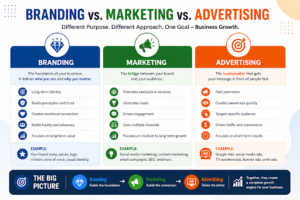
Branding vs. Marketing vs. Advertising
These terms are often used interchangeably, but they serve different functions:
| Branding | Marketing | Advertising |
| Long-term identity | Promotes products/services | Paid promotion |
| Builds perception | Generates leads | Creates awareness |
| Creates emotional connection | Drives engagement | Short-term campaigns |
Branding is the foundation; marketing and advertising are the activities that communicate that foundation to the world.
The Core Elements of a Strong Brand
Every resilient brand rests on a few strategic pillars:
- Brand Purpose – the deeper “why” behind the business
- Brand Vision – where the company aims to go
- Brand Mission – how it plans to get there
- Brand Values – the principles guiding decisions
- Brand Personality – the human traits customers associate with the brand
- Brand Promise – what customers can consistently expect
- Brand Positioning – where the brand sits relative to competitors
- Brand Story – the narrative that ties it all together emotionally
What Is Brand Identity?
Brand identity is the tangible expression of a brand’s strategy – everything customers can see, hear, and feel. This includes logo design, typography, color palette, and overall visual identity, along with brand voice and tone of communication across channels. Photography style and brand guidelines ensure this identity stays consistent whether a customer encounters the brand on a website, a billboard, or a product box.
A recognizable identity doesn’t have to be complicated. A swoosh, a pair of golden arches, or a distinctive four-note jingle can be enough to trigger instant recognition of a company and everything it stands for – which is exactly the point of investing in identity design in the first place.
Types of Branding
Branding isn’t one-size-fits-all. Common types include:
- Corporate Branding – identity of the company as a whole
- Product Branding – identity of a specific product line
- Personal Branding – individual reputation and presence
- Service Branding – identity built around service delivery
- Employer Branding – reputation as a workplace
- Digital Branding – presence across online platforms
- Startup Branding – identity built from the ground up, fast
- Retail Branding – in-store and customer-facing experience
The rise of social media has made personal branding a full category of its own – individual creators now build audiences and negotiate brand deals the same way a corporation manages its identity, treating their name and image as an asset to be developed deliberately rather than left to chance.
Branding and Packaging – Why They Go Hand in Hand
Branding and packaging design work together at the most critical moment: the point of purchase. Packaging is often a customer’s first physical interaction with a brand, and it directly influences buying decisions through shelf impact – the ability to stand out among competitors at a glance. Premium packaging strategies signal quality before a product is even opened, while consistent use of brand colors, typography, and messaging on packaging reinforces recognition built through other channels.
Consumer psychology plays a major role here: unboxing experiences, tactile material choices, and even packaging shape can trigger emotional responses that influence repeat purchases. Product branding and packaging done well doesn’t just protect a product – it sells it.
What Is a Branding Film?
A branding film is a video asset created specifically to communicate a brand’s story, values, and personality – distinct from a straightforward product advertisement. Benefits include stronger brand storytelling, memorable product launch moments, and content that performs well on social media where video consistently drives higher engagement.
Corporate branding films are often used to build trust with investors, partners, or new employees, while shorter cuts serve social media branding efforts. The goal across formats is the same: create an emotional connection that text and static images can’t achieve alone.
Step-by-Step Guide to Building a Strong Brand
- Define your target audience – understand who you’re building the brand for
- Conduct market research – validate assumptions with real data
- Analyze competitors – identify gaps and differentiation opportunities
- Create brand positioning – decide where you stand in the market
- Develop brand messaging – craft the language that represents you
- Design your brand identity – bring the strategy to life visually
- Register your trademarks – legally protect your name, logo, and other core identifiers before they gain wider visibility
- Build a professional website – your most controlled brand touchpoint
- Create brand guidelines – document standards for consistency
- Maintain brand consistency – apply the identity everywhere, every time
- Measure brand performance – track recognition, sentiment, and growth
Common Branding Mistakes Businesses Should Avoid
Even well-intentioned businesses stumble on branding. Watch out for:
- Inconsistent branding across platforms and materials
- Weak or unclear messaging that confuses customers
- Poor logo design that doesn’t scale across formats
- Ignoring customer experience as part of the brand
- Operating without documented brand guidelines
- Copying competitors instead of differentiating
- Inconsistent packaging that breaks brand recall
- A weak or outdated digital presence
- Delaying trademark registration until after a name or logo is already well known – by then, competitors may already be circling
Do Strong Brands Last Forever?
Some brands prove remarkably durable. Stella Artois traces its roots back to 1366, and the Chevrolet Suburban has stayed in continuous production since 1935 – both adapting generation after generation without losing their core identity.
Others don’t survive. Names that were once everyday household staples – Blockbuster, Borders, Toys R Us, Compaq, Oldsmobile, Pan American, F.W. Woolworth, Tower Records, and Howard Johnson’s – have disappeared over the past few decades, usually because they failed to adapt to changing consumer behavior or were mismanaged rather than because branding itself stopped working. (Toys R Us, notably, made a partial comeback in 2022 as a store-within-a-store at Macy’s locations.) The lesson holds either way: a brand isn’t a one-time asset you build and then leave alone. It has to be actively maintained, or it decays.
How Branding Improves SEO, GEO & AI Search
Modern branding directly impacts discoverability. Strong brand authority and E-E-A-T (Experience, Expertise, Authoritativeness, Trustworthiness) signals help businesses appear more often in Google’s AI Overviews and traditional search results. Entity SEO and presence in the Google Knowledge Graph make a brand more recognizable to search algorithms, not just customers.
Branded searches, customer reviews, and brand mentions across the web (even without links) act as trust signals. Combined with digital PR and local SEO, a well-branded business becomes easier for both search engines and generative AI tools to recommend confidently.
How to Choose the Right Branding Agency in Bangalore
Bangalore is home to a growing number of branding agencies, branding companies, and creative studios – making the choice overwhelming. When evaluating a branding agency in Bangalore, consider:
- Industry experience relevant to your business category
- Portfolio evaluation – real, diverse client work, not just concepts
- Creative capabilities across visual, verbal, and digital branding
- Branding strategy depth, not just design execution
- Packaging expertise, if physical products are involved
- Video production capability for branding films
- Digital branding skills across web and social platforms
- End-to-end services, reducing the need for multiple vendors
Quick checklist: Does the agency offer strategy and execution? Can they show measurable results? Do they understand your industry? Is their own branding consistent and professional?
Benefits of Working with a Professional Branding Agency
Partnering with an experienced branding agency brings structured brand strategy, professional logo and packaging design, documented brand guidelines, and cohesive website branding. Agencies also bring content strategy and creative campaign capabilities that maintain long-term brand consistency – something difficult to sustain in-house without dedicated resources.
Why Choose Honeycomb Creative Support?
Honeycomb Creative Support is a leading Digital Marketing Agency in Bangalore, offering strategic brand consulting and end-to-end brand identity development for businesses across Bangalore and beyond. From creative design solutions and packaging design expertise to branding films, digital branding, website design, digital marketing services, and marketing collateral, Honeycomb Creative Support supports brands at every touchpoint.
Industries served include Manufacturing, Healthcare, IT, Real Estate, Retail, FMCG, Startups, and B2B Businesses – giving the team cross-sector experience to tackle diverse branding and digital marketing challenges with practical, tested strategies.
Branding Trends in 2026
Branding continues to evolve alongside technology and consumer expectations:
- AI-powered branding tools speeding up design and strategy work
- Human-centric branding that prioritizes authenticity over polish
- Sustainable branding reflecting environmental responsibility
- Interactive brand experiences across digital platforms
- Video-first branding, especially on social channels
- Personalization at scale
- Voice search optimization for brand discoverability
- GEO (Generative Engine Optimization) for AI-driven search
- Visual search readiness
- Community-led branding built around engaged audiences
Conclusion
Branding is the foundation of a successful business – far more than a logo, it’s the sum of every experience a customer has with a company, and increasingly, a measurable financial asset in its own right. A strong, consistent brand builds trust, recognition, and loyalty that compound over time, creating real business value that shows up on balance sheets as brand equity – value worth protecting through trademarks once it exists. For businesses ready to build or refine their identity, working with an experienced branding agency in Bangalore, like Honeycomb Creative Support, offers the strategic and creative expertise needed to establish a memorable, competitive brand presence.
Frequently Asked Questions
What is branding?
Branding is the strategic process of shaping how a business is perceived through its identity, messaging, and customer experience.
Why is branding important?
It builds trust, recognition, and loyalty, helping businesses stand out and grow sustainably.
What is brand identity?
The visual and verbal expression of a brand – logo, colors, typography, voice, and guidelines.
What is brand equity?
The commercial value a brand adds to a company beyond its physical assets – the reason two otherwise similar businesses can carry very different valuations.
Do I need a trademark for my brand?
Yes, if you want exclusive legal rights to your name, logo, or slogan. Without registration, competitors can legally use a confusingly similar mark and dilute the recognition you’ve built.
What is the difference between branding and marketing?
Branding is the long-term identity; marketing is the activity used to promote that identity.
What does a branding agency do?
They develop brand strategy, visual identity, packaging, and campaigns to build a cohesive brand presence.
How much does branding cost?
Costs vary widely based on scope – from logo design projects to full brand strategy and campaign development.
What is branding and packaging?
The alignment of a brand’s identity with its physical packaging to influence purchase decisions and recall.
What is a branding film?
A video asset built to communicate brand story and values, rather than promote a single product.
Why is packaging important?
It’s often the first physical touchpoint with a customer and directly influences buying decisions.
How do I choose a branding agency in Bangalore?
Evaluate their portfolio, industry experience, strategic depth, and range of services.
Can startups benefit from branding?
Yes – early branding helps startups establish credibility and differentiate from day one.
What industries need branding?
Every industry benefits, though it’s especially critical in competitive sectors like retail, FMCG, and tech.
How long does branding take?
A full brand identity project typically takes several weeks to a few months, depending on scope.
What is rebranding?
The process of updating or overhauling an existing brand’s identity, often due to market shifts or growth.
What are brand guidelines?
A documented reference outlining how a brand’s identity should be applied consistently across all materials.