
Introduction
The healthcare industry depends on precision, reliability, and innovation to deliver safe and effective patient care. From surgical instruments and diagnostic equipment to implantable devices and wearable health technologies, every medical product must meet strict quality and regulatory standards. Even the smallest component plays a crucial role in ensuring the safety, performance, and durability of medical devices.
As healthcare technology continues to evolve, manufacturers are expected to produce highly accurate components while complying with international quality standards. This growing demand has made advanced medical manufacturing processes an essential part of the global healthcare supply chain.
In this article, we’ll explore the key benefits of medical part manufacturing, its importance in modern healthcare, and why choosing an experienced manufacturing partner is critical for producing high-quality medical components.
What Is Medical Part Manufacturing?
Medical part manufacturing is the process of producing precision-engineered components used in medical devices, laboratory equipment, surgical instruments, diagnostic systems, and healthcare technology.
These components are manufactured using advanced technologies such as:
- CNC Machining
- Plastic Injection Molding
- Precision Casting
- 3D Printing
- Laser Cutting
- Micro Machining
Every component must meet strict requirements for dimensional accuracy, material performance, cleanliness, and traceability before it can be used in medical applications.
Why Precision Matters in Medical Manufacturing
Unlike many other industries, healthcare leaves little room for manufacturing errors. Medical components often perform life-critical functions, making precision essential for patient safety and product reliability. Rapid prototyping services also play a vital role in validating medical device designs before full-scale production, helping manufacturers identify potential issues early in the development process. Even minor dimensional variations can affect:
- Device performance
- Surgical accuracy
- Product durability
- Patient safety
- Regulatory compliance
For this reason, manufacturers invest heavily in advanced equipment, quality control systems, and skilled engineering teams.
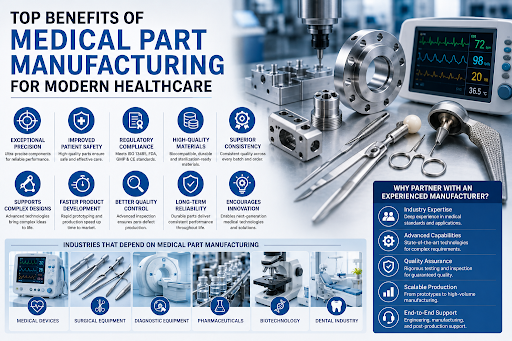
Top Benefits of Medical Part Manufacturing
Exceptional Precision and Accuracy
Medical devices require extremely tight manufacturing tolerances.
Advanced production technologies enable manufacturers to create complex components with outstanding dimensional accuracy and repeatability.
Working with a professional medical part manufacturing partner ensures that every component meets exact engineering specifications and performs reliably in clinical environments.
Precision manufacturing helps reduce product failures while improving overall patient outcomes.
Improved Patient Safety
Patient safety is the highest priority in healthcare.
Accurately manufactured components reduce the likelihood of device malfunction, contamination, or mechanical failure.
Reliable manufacturing contributes to:
- Safe surgical procedures
- Accurate diagnostics
- Consistent treatment outcomes
- Reduced equipment failures
High-quality components ultimately support better patient care.
Compliance with Industry Regulations
Medical manufacturers must comply with strict international quality and regulatory requirements.
Depending on the product and market, manufacturers often follow standards such as:
- ISO 13485
- FDA Quality System Regulations
- Good Manufacturing Practices (GMP)
- CE marking requirements
Compliance ensures medical products are safe, reliable, and suitable for healthcare use.
High-Quality Material Selection
Material selection is critical for medical applications.
Manufacturers choose materials based on factors such as:
- Biocompatibility
- Corrosion resistance
- Sterilization compatibility
- Mechanical strength
- Chemical resistance
Common materials include medical-grade stainless steel, titanium, PEEK, polycarbonate, and other engineering plastics.
Selecting the appropriate material improves product performance and longevity.
Superior Product Consistency
Medical products often require thousands of identical components.
Advanced manufacturing equipment ensures every production batch maintains consistent:
- Dimensions
- Surface finish
- Mechanical properties
- Material quality
Consistency is essential for meeting regulatory requirements and maintaining product reliability.
Support for Complex Designs
Modern healthcare technologies continue to become smaller and more sophisticated.
Medical manufacturing supports highly detailed components with:
- Intricate geometries
- Micro-scale features
- Thin walls
- Complex internal structures
Advanced production methods allow engineers to develop innovative products without sacrificing precision.
Faster Product Development
Rapid manufacturing technologies enable companies to accelerate product development.
Prototype production allows engineers to:
- Validate designs
- Test functionality
- Improve performance
- Resolve engineering challenges
Faster development shortens time to market while reducing overall project costs.
Better Quality Control
Quality assurance is integrated throughout every stage of medical manufacturing.
Inspection methods may include:
- Coordinate Measuring Machines (CMM)
- Optical inspection
- Surface measurement
- Material testing
- Functional testing
- Cleanliness verification
Comprehensive inspection ensures every component meets strict medical specifications.
Long-Term Reliability
Medical devices must perform consistently throughout their intended service life.
Precision manufacturing improves:
- Mechanical durability
- Wear resistance
- Corrosion protection
- Structural integrity
Reliable components reduce maintenance requirements and improve patient confidence.
Encourages Healthcare Innovation
Advanced manufacturing technologies enable engineers to develop next-generation medical solutions.
Innovations supported by precision manufacturing include:
- Robotic surgical systems
- Wearable health devices
- Implantable technologies
- Smart diagnostic equipment
- Minimally invasive surgical tools
Manufacturing innovation directly contributes to improved healthcare outcomes.
Industries That Depend on Medical Part Manufacturing
Medical Device Industry
Manufacturers produce components for diagnostic equipment, patient monitoring systems, infusion pumps, and surgical devices.
Surgical Equipment
Precision manufacturing supports scalpels, forceps, clamps, orthopedic tools, and robotic surgery instruments.
Diagnostic Equipment
Medical testing systems rely on accurately manufactured mechanical and electronic components.
Biotechnology
Biotechnology companies manufacture laboratory equipment, analytical devices, and research instruments.
Dental Industry
Dental equipment, orthodontic tools, implants, and imaging systems all require high-precision components.
Factors to Consider When Choosing a Medical Manufacturing Partner
Industry Experience
Choose manufacturers with extensive experience producing medical-grade components.
Quality Certifications
Verify compliance with recognized quality standards such as ISO 13485.
Manufacturing Technologies
Look for suppliers offering advanced machining, molding, and precision manufacturing capabilities.
Material Expertise
The manufacturer should understand medical-grade materials and their specific applications.
Quality Assurance Systems
Comprehensive inspection procedures are essential for ensuring product consistency and regulatory compliance.
Conclusion
Medical part manufacturing is a cornerstone of modern healthcare, enabling the production of safe, reliable, and high-performance components used in life-saving medical devices and equipment. Through advanced manufacturing technologies, strict quality control, and regulatory compliance, manufacturers help healthcare providers deliver better patient care while supporting ongoing medical innovation.
As the demand for sophisticated healthcare technologies continues to grow, precision manufacturing will remain essential for developing the next generation of medical devices. Partnering with an experienced medical manufacturing company ensures products meet the highest standards of quality, safety, and performance from concept through production.
FAQs
What is medical part manufacturing?
Medical part manufacturing is the process of producing precision components used in medical devices, surgical instruments, laboratory equipment, and healthcare technologies while meeting strict quality and regulatory standards.
Why is precision important in medical manufacturing?
Precision ensures medical devices function accurately, safely, and consistently, reducing the risk of product failure and improving patient outcomes.
Which materials are commonly used in medical manufacturing?
Common materials include medical-grade stainless steel, titanium, PEEK, polycarbonate, silicone, and other engineering plastics selected for their strength, durability, and biocompatibility.
What industries rely on medical part manufacturing?
Medical devices, biotechnology, pharmaceuticals, dental equipment, diagnostic systems, and laboratory technology all depend on precision medical manufacturing.
How do manufacturers ensure the quality of medical components?
Manufacturers use advanced inspection techniques, material testing, dimensional verification, process validation, and internationally recognized quality management systems to ensure every component meets strict medical standards.