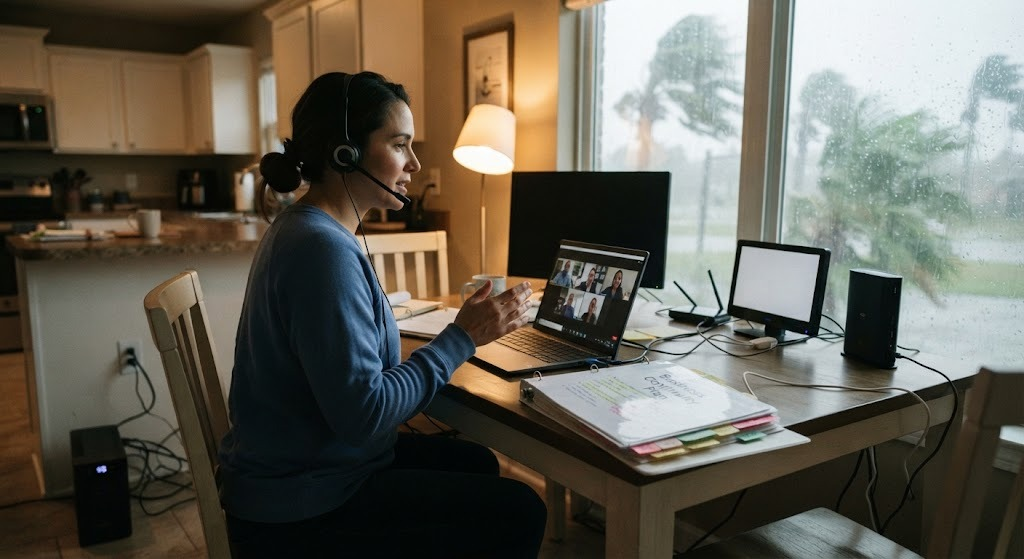

For businesses in Louisiana, hurricane season is not a distant risk. It is a recurring part of the calendar, and it tests technology as much as it tests buildings. A storm does not need to damage an office to disrupt a company. Power loss, flooded data rooms, damaged network lines, and employees who cannot reach the office can each stop work just as effectively.
The firms that recover fastest are rarely the ones with the most expensive equipment. They are the ones that planned their IT around the assumption that the office might be unavailable for days, and tested that plan before it was needed.
Why Storms Expose the Weak Points in Business IT
Day-to-day operations hide a lot of risk. A server closet that works fine in normal conditions may sit in a flood-prone area. A single internet connection may be adequate until the one provider serving a neighborhood goes down. A backup that has never been restored may fail the first time it is truly needed.
Severe weather puts all of these assumptions under pressure at once. This is why storm preparation is really a review of how dependent the business is on one building, one connection, and one set of equipment, and what happens when any of them is removed.
Power and Connectivity Fail First
Most storm-related IT disruption starts with power or connectivity rather than with damaged hardware. Extended outages can outlast battery backups, and a network that depends on a single provider can go dark with little warning.
Practical protection starts with the basics. Battery backup that gives systems time to shut down cleanly, a plan for longer outages, and a secondary internet connection through a different provider or technology all reduce exposure. The goal is not to keep every system running indefinitely. It is to protect data from corruption and keep the most critical functions available for as long as the situation allows.
Backups Need to Live Outside the Building
A backup stored in the same location as the original data offers little protection against a flood or fire that affects the whole site. Businesses in storm-prone areas benefit from keeping backup copies offsite or in the cloud, so that the loss of a physical location does not mean the loss of the data inside it.
Just as important, those backups need to be tested. A backup that runs every night but has never been restored is an assumption, not a safeguard. Regular test restores confirm that the data is complete, that the process works, and that the business knows how long recovery actually takes.
Let Employees Work From Anywhere
If employees cannot reach the office, the business can still operate when its systems are designed for remote work. This depends on having secure remote access, cloud-based tools for email and file sharing, and phone systems that can route calls to mobile devices or home offices.
Firms that already work this way tend to treat a storm as an inconvenience rather than a shutdown. Firms that rely on on-premises systems and desk-bound phones often find that even a short closure halts nearly everything, because there is no way to reach the tools staff depend on.
Keep Communication Channels Working
During and after a storm, clear communication matters as much as technology. Employees need to know whether the office is open, how to access systems remotely, and who to contact for help. Clients need to know whether the business is operating and how to reach someone.
A communication plan that lists contact methods, designates who is responsible for updates, and does not depend solely on systems that may be offline keeps the business coordinated when normal channels are disrupted. Mobile-friendly tools and a reliable way to reach staff outside the company network are worth setting up well before the season begins.
Plan, Document, and Test Before the Season Starts
Recovery goes faster when the plan is written down and has been rehearsed. A useful plan identifies which systems matter most, how long the business can tolerate being without each one, who is responsible for each step of recovery, and how to reach everyone involved.
Walking through the plan before storm season, even as a simple tabletop exercise, tends to reveal gaps that are far easier to fix in calm conditions. Contact lists get updated, forgotten dependencies come to light, and the people who will carry out the plan understand their roles before the pressure is on.
How Mindcore Technologies Helps Louisiana Businesses Prepare
Mindcore Technologies has spent more than 30 years helping businesses plan for the disruptions that put technology at risk. Under the leadership of Matt Rosenthal, CEO of Mindcore Technologies, the company delivers IT services in Lafayette that include proactive monitoring, backup and disaster recovery planning, and secure remote access built to keep operations moving when the office is not available.
Businesses working with Mindcore get recovery plans that have been documented and tested, along with the ongoing management that keeps backups, remote access, and connectivity ready before a storm approaches rather than after.
Conclusion
Hurricane season rewards the businesses that prepared early. Protecting power and connectivity, keeping tested backups outside the building, enabling remote work, and maintaining a written, rehearsed plan all reduce the time a company spends offline when a storm hits. The investment is modest compared with the cost of extended downtime, and most of it can be completed well before the first storm of the season forms.
About the Author
Matt Rosenthal is the CEO and President of Mindcore Technologies, a full-service IT consulting and cybersecurity firm serving businesses across Florida, New Jersey, Maryland, South Carolina, Louisiana, Texas, and nationwide.
With more than 30 years of experience in IT leadership, managed services, and technology strategy, Matt has helped organizations across healthcare, financial services, and professional services build disaster recovery and business continuity plans that hold up under real conditions. He holds an MBA in Technology Management, is a certified Project Management Professional (PMP), and is the host of Digging In, a weekly podcast on success in business, life, and health.