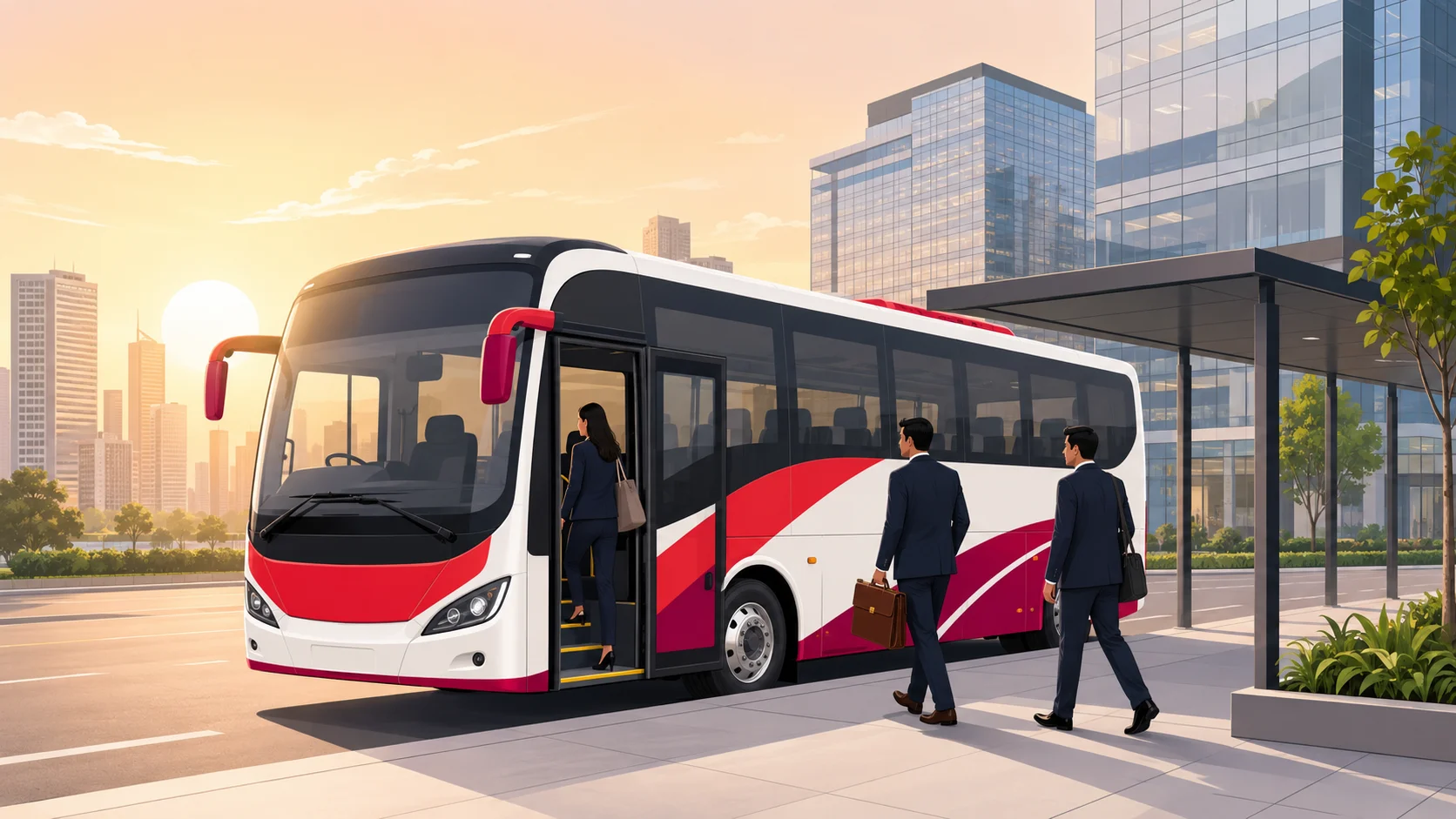

Every company running employee transport eventually faces the same decision point: keep managing it in-house through a patchwork of local vendors or hand the whole operation to a dedicated transport provider built specifically for corporate mobility. Both approaches work for some organizations. Neither is automatically the right answer, and the choice usually comes down to scale, shift complexity, and how much operational bandwidth a company actually has to spare for managing commute logistics.
Here is a practical breakdown of what each model actually involves, where each one tends to succeed or fall short, and how to think through the decision for your own organization.
What in-house vendor management typically looks like
In-house management usually means an HR or admin team sources vehicles from one or more local cab operators, negotiates rates directly, and coordinates pickups and drop-offs through phone calls, spreadsheets, or basic scheduling tools. For a smaller workforce with a single shift and a handful of regular routes, this can work reasonably well for a while.
The cracks tend to show up as the workforce grows or shift patterns become more complex. Coordinating routes across multiple vendors, verifying drivers consistently, managing breakdowns or no-shows, and keeping safety standards uniform across different local operators all become harder to manage with the same small internal team that was originally just booking cabs. Scalability is the most common breaking point. A setup that worked for 50 employees on one shift often falls apart for 500 employees across three shifts and multiple pickup zones.
What outsourced employee transportation actually changes
Outsourcing to a dedicated provider shifts the operational weight away from the internal team. Instead of managing individual vendor relationships, route planning, and driver verification in-house, the company works with one accountable partner who handles fleet availability, route optimization, driver training, and day-to-day coordination as a core part of their business, not a side responsibility layered onto an HR function.
The practical differences tend to show up in a few specific areas. Reliability improves because a dedicated provider maintains backup fleet capacity for breakdowns or last-minute disruptions, rather than scrambling to find a replacement vehicle through informal channels. Safety standards become more consistent because drivers are background-verified and trained to a uniform standard rather than varying by whichever local vendor happens to be available. And reporting becomes considerably easier, since most established transport providers offer centralized dashboards that give HR and admin teams visibility into routes, timings, and costs without needing to chase multiple vendors for updates.
For companies operating in spread-out business hubs like Hyderabad, where IT, ITES, and manufacturing workforces are distributed across multiple business districts and shift patterns rarely line up neatly, this difference becomes more pronounced. A provider already familiar with employee transportation services in Hyderabad can plan routes around existing residential clusters and traffic patterns far more efficiently than an internal team building that knowledge from scratch.
Where in-house management can still make sense
In-house vendor management is not automatically the wrong choice. For very small workforces, single-shift operations, or companies with highly localized, low-complexity routes, the overhead of an outsourced contract may not be worth the cost difference. Some organizations also prefer the direct control that comes with managing vendor relationships themselves, particularly if they already have strong local vendor relationships and a team with the bandwidth to manage them properly.
The trade-off is that this model places the burden of driver verification, safety compliance, and contingency planning entirely on the internal team. If that team is small, or if transport is a secondary responsibility layered on top of other HR duties, gaps tend to appear during exactly the moments when they matter most: a late-night shift disruption, a sudden driver no-show, or a safety incident that requires an immediate, practiced response rather than an improvised one.
Where outsourcing becomes the more practical choice
The case for outsourcing strengthens considerably as headcount grows, shifts multiply, or safety requirements become more demanding. Organizations running 24/7 operations, employing a significant number of women on night shifts, or operating across multiple cities tend to benefit most from a dedicated provider’s existing infrastructure: GPS-enabled vehicles, a functioning control room, verified drivers, and the kind of route flexibility that comes from operating at scale across many clients rather than serving one company’s transport needs in isolation.
Cost predictability is another factor worth weighing carefully. In-house arrangements built around informal vendor relationships or ad hoc cab bookings often carry hidden costs, surge pricing, inconsistent billing, and last-minute premium charges that are difficult to forecast accurately. The broader case for why employee transportation services matter for business success rests largely on this point: outsourced contracts with fixed-rate structures give finance teams a far clearer picture of monthly transport spend than fragmented, vendor-by-vendor billing ever does.
The decision in practice
The right answer depends less on company size alone and more on operational complexity. A 200-person single-shift office in one location might manage perfectly well with a couple of trusted local vendors. A 2,000-person operation running three shifts across multiple pickup zones in a city like Hyderabad is taking on considerably more risk trying to manage that complexity internally rather than working with a provider whose entire operating model is built around exactly that scale of problem.
For organizations weighing this decision, the more useful question is not simply in-house versus outsourced, but whether the current internal setup can genuinely absorb a safety incident, a sudden vendor failure, or a doubling of headcount without falling apart. If the honest answer is no, that is usually the clearest sign that a dedicated transport partner is worth the conversation.