

We live in a time where speaking is easier than writing. Ideas are recorded instantly—through voice notes, meetings, podcasts, and interviews. Audio has become the fastest way to capture thoughts, yet it remains one of the least efficient formats when it comes to using that information later. You can hear it, but you can’t quickly organize it, search it, or reshape it.
Audio-to-text technology bridges this gap. It converts spoken language into structured content, allowing ideas to move from raw conversation into something refined and actionable. With tools like Devoice Ai, this shift happens almost instantly, changing how individuals and businesses handle information.
When Speech Becomes Difficult to Manage
Recording is effortless, but managing recordings is not. A single audio file can contain valuable insights, but extracting them requires time and patience. Listening repeatedly just to find one key moment is inefficient, especially in fast-paced environments.
Text removes this friction. Once speech is converted into written form, it becomes flexible. You can jump to specific sections, highlight important points, and restructure content without replaying anything. This transformation turns audio into a resource rather than a limitation.
The Rise of Smart Transcription Systems
The journey from manual transcription to AI-driven solutions has been transformative. What once required hours of careful listening and typing can now be completed in minutes.
Modern systems rely on machine learning models trained to recognize speech patterns, understand context, and predict language flow. They don’t just convert words they interpret meaning. This results in transcripts that are not only accurate but also readable.
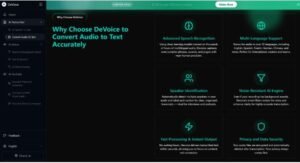
Devoice Ai reflects this advancement by delivering text that feels natural, capturing both the words and the rhythm of real conversation.
Unlocking the Value Hidden in Voice
Every spoken interaction contains information, but without transcription, much of it remains underutilized. Converting audio into text reveals that hidden value.
A recorded brainstorming session can turn into structured ideas.
A lecture can become detailed study notes.
A conversation can evolve into publishable content.
This ability to transform voice into multiple outputs makes audio to text tools essential for modern workflows.
Speed That Matches Modern Demands
Time efficiency is one of the biggest advantages of AI transcription. In environments where decisions need to be made quickly, waiting hours for manual transcripts is no longer practical.
AI tools deliver results almost instantly, allowing users to move forward without delay. This speed is particularly valuable in content creation, business communication, and research.
With Devoice Ai, users can go from recording to ready-to-use text in a fraction of the time traditional methods require.
Clarity Even in Complex Recordings
Real-world audio is rarely perfect. Background noise, multiple speakers, and varying audio quality can make transcription challenging. Older systems often struggled in these situations, producing incomplete or inaccurate results.
Modern tools are designed to handle these complexities. They can separate voices, reduce noise interference, and adapt to different accents and speaking styles. This ensures that the final transcript remains clear and reliable.
Devoice Ai is built to perform under these conditions, maintaining accuracy even when the input is less than ideal.
Expanding Access Through Text
Accessibility is a critical part of communication. Audio alone excludes those who cannot easily listen or prefer reading. Transcription opens the door to a broader audience by making content available in multiple formats.
It supports individuals with hearing challenges and helps non-native speakers better understand information. It also allows content to be translated, edited, and shared more widely.
Strengthening Digital Presence with Text
In the digital space, text drives visibility. Search engines rely on written content to index and rank information. Audio files, on their own, cannot achieve the same level of reach.
By converting audio into text, users can improve discoverability and expand their audience. Transcripts can be optimized, formatted, and repurposed into different types of content, increasing their overall impact.
A Natural Fit for Everyday Workflows
One of the strengths of audio to text technology is how easily it integrates into daily routines. It doesn’t require major changes just record as usual and convert afterward.

The resulting text can then be edited, stored, or shared depending on the need. This simplicity makes transcription a practical addition to both personal and professional workflows.
Looking Ahead: The Future of Voice and Text
The relationship between voice and text is continuing to evolve. Real-time transcription is becoming more common, enabling live conversations to be captured instantly. Multilingual capabilities are improving, making global communication easier.
As these technologies develop, the line between speaking and writing will become even more fluid. Voice will no longer be a separate format—it will be part of a continuous content cycle.
Efficiency as a Modern Necessity
In a world driven by speed and information, efficiency is not optional. Tools that reduce effort while increasing output are essential. Audio-to-text technology fits perfectly into this need by automating one of the most time-consuming tasks.
Instead of focusing on transcription, users can focus on ideas, creativity, and decision-making. This shift leads to better productivity and more meaningful results.
Giving Voice a Lasting Form
Audio captures ideas in their most natural form, but without structure, those ideas can fade or remain unused. Converting speech into text gives those ideas permanence and clarity.
With Devoice Ai, this process becomes simple and efficient, turning voice into something that can be shaped, shared, and expanded.
In the end, it’s not just about converting audio into text—it’s about turning spoken moments into lasting value.