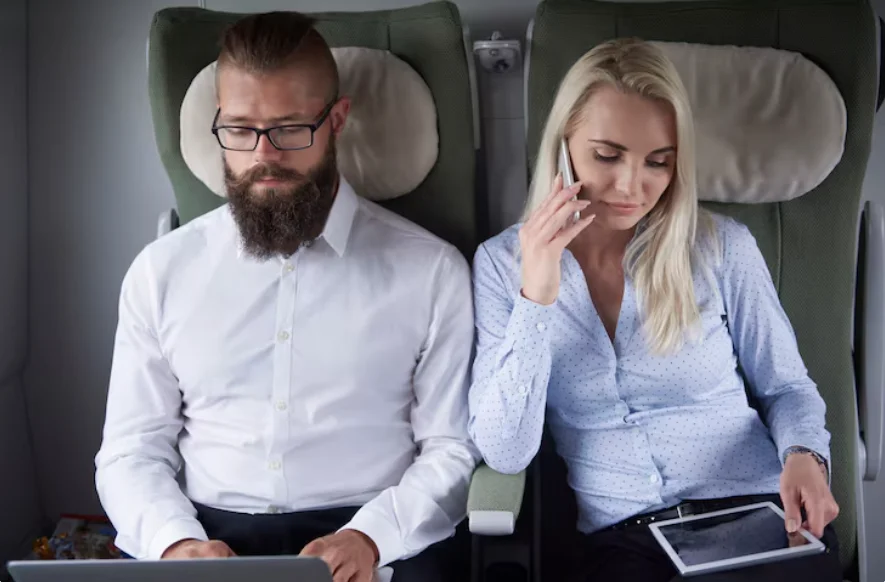

People talk about premium flying as if it’s a collection of features, but most passengers judge it far more simply. They sit down, and within minutes, they know whether the flight will feel manageable or exhausting. That reaction cuts across age, ticket type, and flight length. It’s why, even as cabins evolve, seating comfort remains the most decisive factor in luxury aircraft interiors. Strip everything else away, and the seat is still where the experience either succeeds or fails.
Premium flying has always been defined by seating. You can ignore décor. You can tolerate limited storage. You cannot escape a seat that doesn’t work for your body.
Comfort for every age.
Different people have different experiences on flights. Younger passengers often shift position constantly. They lean forward, sit cross-legged, rotate slightly, and rest their elbows at odd angles. Seats that are too rigid feel restrictive very quickly. For them, comfort comes from flexibility. The seat needs to respond without pushing back.
Older passengers tend to sit more still, but that doesn’t mean their needs are simpler. Pressure points become an issue faster. Lower back support matters more. Getting in and out of the seat cleanly becomes important, especially on shorter flights where there’s less time to “settle in”.
A premium seat that works across age groups is designed to accommodate variation. And getting it right is very important!
Short flights are less forgiving than long ones.
Most people think that comfort matters most when you’ve got a 12-hour flight ahead of you. In reality, short flights can be more punishing. On a one-hour sector, there’s no time to adjust, adapt, or mentally settle. If the seat doesn’t feel right immediately, the entire flight feels longer than it is.
On short flights, passengers often remain upright. Recline might not even be used. That puts pressure on seat geometry. The backrest has to support posture without relying on adjustment. The seat pan has to distribute weight evenly without the benefit of shifting positions over time.
Long flights present different challenges. Over hours, materials compress, temperatures change, and small design flaws become obvious. A seat that feels fine for forty minutes may become tiring after three hours if cushioning collapses or support migrates.
Premium seating succeeds when it handles both extremes. It shouldn’t feel optimised for one at the expense of the other.
Why first class raised the bar for everyone:
First class cabins played a quiet but important role in redefining seating comfort. Because they carried fewer passengers and commanded higher expectations, they became a testing ground for new ideas.
Seats in first class were built differently. Cushions were layered instead of stacked. Recline mechanisms became smoother and more controlled. These changes weren’t immediately visible, but passengers noticed how the seats behaved over time.
What’s interesting is how those lessons spread. Business class adopted them. Premium economy borrowed selectively. Even private aviation absorbed many of the principles, though applied in different ways.
The influence of first-class proved that seating comfort could be engineered rather than improvised.
Material choices do more than people realise.
Materials play a larger role in seating comfort than most passengers realise. And no, it’s not just about softness or appearance. It’s about how materials behave under use.
Premium seats now use materials chosen for consistency rather than impact. Cushions are designed to recover shape. Upholstery is treated to remain stable across temperature changes. Stitching is placed to avoid ridges where the body bears weight.
These decisions don’t draw attention to themselves, but they define whether a seat remains comfortable across repeated use. In premium flying, durability and comfort are inseparable.
What makes luxury seats feel different:
One reason luxury airplane seats feel noticeably different is restraint. They don’t chase novelty. Instead, they prioritise predictable behaviour.
Recline is controlled, and seat support remains consistent across positions. Armrests don’t wobble or shift under pressure. Basically, the seat doesn’t surprise you.
That predictability is what premium passengers value most. It reduces fatigue because the body doesn’t have to constantly compensate.
Comfort is constant.
Technology evolves. Layouts change. Cabin aesthetics come and go. But seating comfort has remained the constant measure of premium flying.
No matter who’s flying or how long they’re in the air, a good seat just makes the whole experience feel better. A bad one lingers long after landing, even if you were on the most expensive private jet seats. That’s why, for all the effort that goes into interiors, the seat is still the thing people remember most.