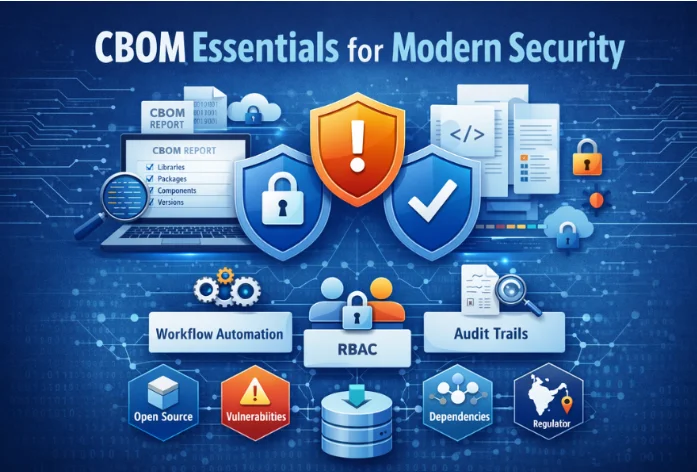

Most businesses know what cryptography they use, but very few know where, how and why it is used in their systems. Encryption libraries, TLS settings, key lengths, certificates and algorithms are often hidden deep inside old systems, third-party components and applications. This lack of visibility creates a growing risk that goes unnoticed.
Recent events involving weak algorithms, expired certificates and broken cryptographic implementations have shown that failures in cryptography don’t happen very often at the policy level. They happen at the implementation and lifecycle level. This is the exact problem that a CBOM is meant to solve.
A cryptographic bill of materials or CBOM does not replace encryption standards or compliance controls. Instead, it gives operational clarity by answering important questions that security teams struggle with during audits and incidents.
This guide explains what a CBOM is, why it’s important and how businesses should use it in real life.
What is a CBOM?
It is a structured inventory that shows all the cryptographic assets that an application or system uses. Unlike usual asset inventories, it only focuses on cryptographic elements rather than infrastructure or software components.
A standard cryptographic bill of materials includes:
- Cryptographic algorithms in use
- Key lengths and setups
- Information about certificates and expiry timelines
- Versions and libraries for cryptography
- Key storage and management mechanisms
- Dependencies linked to cryptographic operations
The goal is not to document everything, it is to make cryptographic risks clear and easy to act on.
Why Cryptographic Visibility is a Growing Problem
Cryptography failures are not usually caused by ill intent. They usually happen because of poor visibility and uncontrolled growth.
Most businesses have problems like:
- Legacy algorithms still in use in production systems.
- Certificates that expire without clear ownership
- Weak crypto inherited from third-party elements
- Inconsistent encryption standards between teams
- No clear link between cryptography and business impact.
Without a CBOM, these problems stay hidden until something breaks or is exploited.
How CBOM Differs from SBOM (And Why Both Are Needed)
Although they are usually discussed together, they solve different problems.
An SBOM answers:
- What parts of the software are in use?
A CBOM answers:
- How does cryptography work inside those components?
Some of the main differences are:
- SBOM focuses on dependencies, whereas CBOM focuses on how cryptography works.
- SBOM keeps track of libraries, while CBOM keeps track of algorithms, keys and certificates.
- SBOM supports vulnerability response, and CBOM supports crypto agility and compliance.
A cryptographic bill of materials complements SBOMs by exposing risks that SBOMs can’t see.
What a Practical CBOM Actually Includes
A usable CBOM has:
- Algorithms: AES, RSA, ECC, SHA variants, TLS versions
- Strength parameters: Key sizes, hash lengths, cipher modes
- Implementation context: Where and how crypto is used
- Libraries: OpenSSL, BoringSSL, custom crypto modules
- Key management: HSM usage, KMS integrations, rotation policies
- Certificate lifecycle: Issuers, expiry dates, trust chains
Without this depth, a cryptographic bill of materials isn’t very useful for operations.
Why it Matters for Real-World Security Operations
They are very important during moments of pressure – not during calm periods.
They are most important when businesses need to:
- Respond to vulnerabilities in cryptography
- Identify if you are using weak or outdated algorithms
- Get ready for compliance or regulatory audits.
- Manage certificate expirations
- Transition to post-quantum cryptography
In these cases, it helps you make quick, confident decisions instead of guessing.
CBOM and Crypto Agility
One of their most overlooked benefits is crypto agility.
Crypto agility refers to the ability to:
- Identify where certain algorithms are used
- Quickly replace weak or broken cryptography
- Change settings without breaking systems
- Adapt to regulatory or standards changes
Without a cryptographic bill of materials, crypto agility is almost impossible. Teams simply do not know where to start.
Common Mistakes Organisations Make
Most CBOM projects fail because of operational problems, not the technical ones.
Some common mistakes are:
- Treating it as a one-time inventory
- Ignoring runtime cryptographic usage
- Only paying attention to compliance checkboxes
- Not giving ownership for crypto assets
- Not including it in security workflows
Like the systems it documents, a CBOM must evolve continuously.
How CBOM Supports Compliance and Audits
Regulators are becoming more interested in how cryptography is implemented – not just whether encryption exists.
A well-maintained CBOM supports:
- Evidence-based audit responses
- Faster compliance assessments
- Clear documentation of cryptographic controls
- Reduced audit friction and rework
Teams can show cryptographic posture with confidence instead of scrambling for answers.
Next Steps
To improve their cryptographic risk management, organisations should first figure out where cryptography is used now and where visibility is missing. This often shows problems with ownership, lifecycle management and algorithm governance.
A structured CBOM program helps businesses move from assumptions to clarity. CyberNX is a cybersecurity firm that helps businesses adopt CBOM as part of a broader cryptographic and supply chain security strategy. Their in-house built SBOM management tool covers CBOM requirements. Plus, they can work alongside your team to check your readiness, implement tools and convert visibility into action.
Conclusion
Cryptography is what makes people trust modern digital systems, but it is often poorly understood and poorly managed. A CBOM gives you the information you need to see how cryptography is actually implemented, not just how it is intended to work.
For security and engineering teams, a cryptographic bill of materials enable faster response, better compliance and long-term crypto agility. As cryptographic threats evolve and regulatory inspection increases, it’s becoming an essential part of modern cybersecurity, not an optional extra.