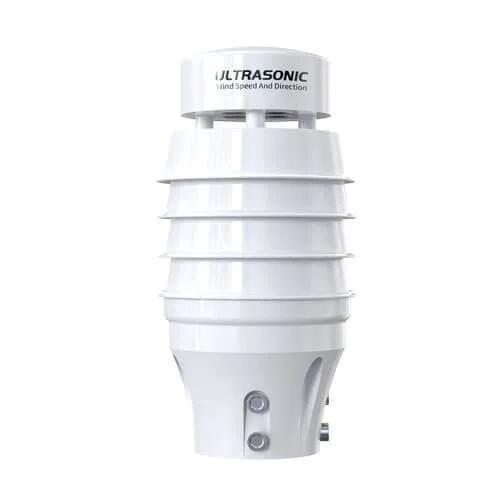

Accurate measurement of wind is important for many industries, such as aviation, renewable energy, environmental monitoring, and smart agriculture. For decades, meteorologists have relied on conventional mechanical anemometers, but advances in sensor technology have opened the door to speedier, more accurate alternatives. Ultrasonic wind measurement is one of these advancements that have become the de facto choice for companies looking for long-term reliability, high accuracy, and low maintenance.
Ultrasonic technology helps engineers and environmental professionals take more accurate measurements at reduced running costs as weather monitoring systems continue to improve.
Why We Need Better Wind Monitoring
Wind influences many of our normal activities. Reliable wind information is vital to airports to assure safe aircraft takeoffs and landings. Wind farms employ continuous wind data to enhance energy output. Construction businesses monitor the wind to keep their employees safe working with cranes and other heavy equipment. Reliable wind data also benefits agriculture, allowing farmers to ventilate greenhouses, schedule watering, and apply pesticides. Precise wind measurements are crucial for operational efficiency, productivity, and safety, as these activities rely on precise environmental data.
Challenges in Traditional Mechanical Anemometers
Despite their simple construction and low cost, classic cup and vane anemometers are still widely used. However, they do have a number of downsides.
Friction, dust, moisture, and ice are constantly wearing mechanical parts. Moving parts can wear out and become less accurate over time, but bearings may have to be changed on a regular basis. Extreme weather can also mean more maintenance, which increases operating expenses and sometimes downtime. Considering such restrictions, many companies have chosen enhanced sensor technologies that remove all moving elements.
How Does Ultrasonic Technology Work
Ultrasonic wind sensors do not have spinning elements and use sound waves to measure wind speed and direction, unlike mechanical devices. Pairs of ultrasonic transducers transmit and receive sound pulses along fixed paths. The wind alters how long the sound waves take to travel across the measurement region.
The device accurately measures wind direction and wind speed by comparing transit times in different directions. No moving mechanical parts means that measurements are constant and maintenance needs are drastically reduced. Ultrasonic anemometers are characterised by high accuracy and fast response time and can be used continuously in outdoor conditions.
Advantages of Ultrasonic Wind Sensor
Modern ultrasonic wind sensors offer a number of major advantages over traditional mechanical instruments.
High measurement accuracy
Ultrasonic sensors can accurately monitor wind, even at relatively low wind speeds. Because they react quickly, they are very valuable for recognizing turbulence and abrupt gusts.
No Moving Parts
No moving parts means there is no mechanical wear and tear, which means fewer maintenance needs and greater reliability over time.
Fast data collection
Real-time monitoring of the environment is needed in aviation, wind energy, and scientific research, and high-frequency signals from ultrasonic technology could be used for that.
Reliable Performance
These sensors still prove effective in rugged outdoor environments where exposure to salt, dust, or humidity can limit the life time of traditional mechanical instruments.
Applications Across Industries
Ultrasonic wind sensors are versatile, hence valuable in many professional applications.
Renewable Energy: Wind farms analyse wind conditions regularly to optimise energy production and improve turbine performance.
Meteorological Stations: National weather organisations rely on accurate wind data to monitor the climate and provide forecasts.
Agriculture: Wind conditions observed by farmers prior to pesticide application to prevent chemical drift and enhance productivity.
Marine Operations: Wind monitoring is utilised by ports, ships and offshore rigs to improve operational planning and navigation safety.
Industrial Facilities: Manufacturing and chemical facilities observe their environment to guarantee safe working conditions.
Choosing the Right Wind Measurement Method
The selection of a wind sensor is influenced by several factors such as measurement accuracy, environmental conditions, communication interfaces and maintenance considerations.
Organisations should also consider the ease of integrating the equipment with existing weather stations, industrial control systems, or IoT monitoring platforms. In difficult or isolated places where the system is intended to operate constantly, long interfaces and endurance are particularly important.
Businesses interested in learning more about selecting an ultrasonic anemometer can explore available solutions based on their monitoring requirements, installation environment, and desired level of measurement precision.
Towards More Intelligent Environmental Monitoring
With the growing interconnection of environmental monitoring, ultrasonic wind sensors are being integrated into cloud-based platforms and Internet of Things ecosystems. It is now possible to transmit wind data in real-time instantaneously to automated control systems, smartphone apps and remote dashboards.
Artificial intelligence is also beginning to enhance wind monitoring, looking at past weather patterns, finding anomalies, and helping with predictive maintenance strategies. These innovations reduce equipment downtime and operational risks while allowing businesses to make choices faster.
Conclusion
For companies that rely on reliable environmental data, accurate wind measurement has become a critical need. Conventional mechanical anemometers still have many applications, yet ultrasonic technology provides distinct advantages in accuracy, robustness, response time, and maintenance.
With the proliferation of smart monitoring systems across industries, ultrasonic wind sensors will be playing an increasingly important role in enabling safer operations, improving efficiency and permitting better data-driven decision-making. “By investing in cutting-edge wind measurement technology today, businesses can future-proof themselves against the increasing demands of the connected world of tomorrow.