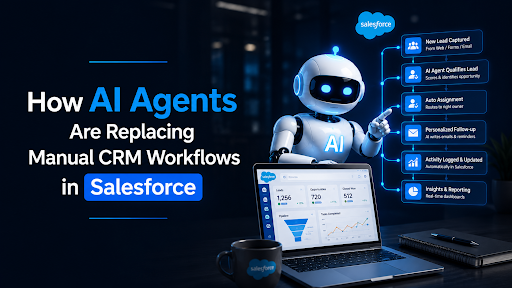

The company has always been the mainstay of CRM in all businesses. From lead generation and customer interaction to revenue forecasts and customer service support, the Salesforce system has revolutionized the way businesses conduct themselves when it comes to relationships. Nonetheless, one thing has been constant in this process – there is too much manual work involved.
Even today, sales reps waste a lot of time updating their opportunities’ status after meeting them. Customer service reps must sort out cases manually before passing them on to the respective department. Most marketing teams create audience segments by applying filters and generating reports. All these tedious tasks might not seem much in isolation, but they eat away precious hours that could otherwise have been spent nurturing the relationship with the customers or making the deal.
This is where AI agents are making all the difference.
In contrast to automation, which follows pre-decided rules, AI agents understand the context, analyze information, take decision, and perform actions with little to no human intervention at all. With Salesforce becoming an AI-first platform over time, organizations are rethinking their way of working within their CRM.
Businesses spending on Salesforce Development Services are now considering AI-based workflows.
Understanding AI Agents in Salesforce
AI agents are intelligent machines that perform functions that usually require human intervention. These agents can understand customer discussions, analyze information from the CRM system, spot patterns, suggest courses of action, and even implement processes without requiring constant monitoring.
Unlike rule-based automation, AI agents do not rely on predefined instructions. These agents use machine learning, natural language processing, and contextual reasoning to arrive at their decisions.
For instance, after a sales discussion, an AI agent will be able to summarize the discussion, find out the objections from the customer, change the stage of the sales process, set up future actions, prepare an email message, and inform team members. What previously required several updates on the CRM system can now take place in just a few minutes.
This new approach lets employees spend less time on maintaining the CRM system and more time working on strategic matters.
Why Manual CRM Workflows Have Become a Bottleneck
However, most organizations have spent a lot in Salesforce; there are several everyday operations that are done manually.
Let us take an example of the sales process. The representative joins the product demonstration, notes down the information regarding the discussion, updates the customer data, moves the opportunity phase, sets follow up actions, and alerts the solutions team on the customer’s needs. Every task takes only a couple of minutes; however, doing the task repeatedly every day in several opportunities makes a huge difference.
The same problem is witnessed in customer service support where agents manually go through the cases, determine their priorities, set ownership, and look up knowledge articles.
These manual processes create several business challenges:
Inconsistent CRM Data
Employees use different methods to record information. While some enter all the information that is possible, others only update the required fields. Eventually, customer profiles will be either insufficient or inaccurate, causing teams to find CRM reports unreliable.
Delay in Customer Responses
Manually assigning leads or cases to specific sales or support representatives increases response time. This could prove problematic, especially if businesses operate in highly competitive environments.
Reduced Efficiency
Salespeople and customer support specialists are hired to create relationships and provide help to customers. The need to perform administrative tasks limits their time for valuable customer engagement activities.
Poor Visibility
Business leadership needs up-to-date CRM data for proper planning and performance tracking. Delays in information updates reduce the reliability of business decision-making.
These challenges made businesses consider other options beyond automated CRM workflows.
AI Agents vs Traditional Workflow Automation
Automation capabilities have been offered by Salesforce for many years now via the use of technology such as Flow, Workflow Rules, and Apex. These are useful technologies but are limited to certain circumstances.
For instance, a workflow may be programmed to send an email automatically once a lead attains a certain score level. This, however, does not know whether the consumer is actually interested, compares previous interactions, or needs a sales manager’s attention.
AI agents add intelligence to automation.
| Traditional Automation | AI Agents |
| Executes predefined rules | Understands business context |
| Performs repetitive actions | Makes informed decisions |
| Requires manual updates | Learns from available data |
| Limited flexibility | Adapts to changing scenarios |
| Works within fixed workflows | Handles end-to-end processes |
Instead of replacing existing Salesforce automation, AI agents build upon it by introducing reasoning and contextual understanding.
Six Salesforce Workflows AI Agents Are Already Transforming
1. Intelligent Lead Qualification
The selection of leads for follow-up has usually involved the screening of new leads by sales reps.
AI agents facilitate this task by analyzing several parameters at a glance, such as industry, company size, engagement history, website visits, conversation history, and purchase intent.
Instead of allocating leads using fixed score parameters, AI agents select the most promising prospects and assign them to the right sales representative.
This is done not only to save time but also to avoid wasting effort on unproductive leads.
2. Automated Opportunity Management
Keeping opportunity records updated is one of the most time-consuming responsibilities for sales teams.
AI agents can monitor emails, meeting transcripts, calendar events, and CRM activity to identify important changes within a sales cycle.
Instead of asking sales representatives to update every interaction manually, the AI can:
- Recommend stage changes.
- Capture meeting summaries.
- Detect customer objections.
- Highlight competitive mentions.
- Suggest next-best actions.
- Create follow-up tasks automatically.
The result is a pipeline that reflects real-time customer activity rather than delayed manual updates.
3. Smarter Customer Service Operations
Service representatives generally get a large number of queries from customers on a daily basis.
In the conventional method, the representative analyses the query and decides which department is suitable for it.
AI representatives make it easier by analyzing the intent of the customer, recognizing its urgency level, judging from the record of support provided, and routing the query accordingly.
The agent also recommends the related article from the knowledge base, suggests the response, and even identifies the queries that need escalation.
4. CRM Data Cleansing and Maintenance
Even the most advanced CRM system will lose its relevance once the data becomes obsolete.
The problems such as duplicates of contacts, lack of information, inconsistencies in naming, and gaps in the opportunity records decrease the reporting accuracy and cause misunderstandings within different departments.
AI agents constantly track any inconsistency in CRM data.
They will be able to detect duplicates, suggest changes, standardize the customer information, and alert about any missing information.
Thus, regular maintenance makes CRM healthy without any cleaning campaigns.
5. Personalized Customer Engagement
The modern customer demands a more personalized experience rather than a generic one.
AI-powered agents look into past purchases, browsing history, support conversations, and engagements of customers to help devise a personalized approach towards the customer.
In place of sending the same follow-up emails to all potential clients, there are recommendations for the sales and marketing team to approach each customer differently.
6. Automated Sales Reporting
Reporting sales statistics normally entails gathering information from several dashboards prior to giving updates to the executive teams.
With AI bots, managers are spared the task of having to create the reports since they automatically create performance statistics, identify pipeline dangers, note any abnormal trends, and make recommendations regarding aspects that need management attention.
The Business Impact of AI Agents in Salesforce
However, the importance of AI-enabled agents goes beyond reducing the burden of human intervention. When mundane CRM tasks are automated intelligently, companies start experiencing the gains in their sales, customer service, marketing, and operations departments.
Firstly, automation increases the efficiency of all involved parties. Salespeople can save time that was spent on entering the customers’ information and opportunity updates. Customer service representatives can concentrate on solving problems of clients rather than on moving tickets or finding any related documents. Moreover, marketing departments get instant access to clients’ data and can develop marketing campaigns based on recent client behavior.
Secondly, data accuracy improves significantly. As agents collect and update information continuously, CRM records become more accurate and consistent, which results in better forecasting, reporting, and decision-making in general.
Finally, the introduction of AI agents positively affects the customer experience itself. Clients receive fast responses, individualized suggestions, and follow-up communications as AI eliminates any delays caused by manual data updates. The company can respond immediately based on the customer data.
Thus, for those companies that operate with large number of customers and sales teams, such changes will give them a competitive advantage.
Challenges Businesses Should Consider Before Adopting AI Agents
While AI agents offer tremendous opportunities, successful implementation requires more than simply enabling AI features within Salesforce.
Data Quality Still Matters
The success of AI depends on the data provided to it.
In cases where customer information contains duplicated data, missing columns or old information, the AI agents will provide misleading recommendations or automate incorrect actions.
Prior to implementing any AI process, companies need to check the quality of the CRM data.
Define Clear Governance Policies
AI agents will have access to client data from several different systems. Companies need to make sure that sensitive data is safe and that AI agents operate within specified security and compliance policies.
It is important to answer questions like who will authorize actions by AI agents, what processes should be done manually, and how customer data should be processed prior to deployment.
Good governance creates trust while mitigating risks.
Prepare Employees for Change
The greatest misconception about artificial intelligence is the idea that AI is meant to replace people.
On the contrary, the purpose of AI agents is to take care of all the mundane paperwork, so the employees can dedicate their time to helping customers and making important decisions.
Companies that train their employees about AI and its benefits have a smoother transition compared to those companies that are purely focused on implementing new technologies.
Best Practices for Implementing AI Agents in Salesforce
Introducing AI into Salesforce should be treated as a business transformation rather than a technology upgrade. A phased approach usually delivers better results than trying to automate every process at once.
Start with High-Impact Workflows
The best place to begin is with repetitive tasks that consume the most employee time.
These may include:
- Lead assignment
- Opportunity updates
- Case categorization
- Meeting summaries
- Follow-up reminders
- Sales reporting
Automating these activities creates immediate value while allowing teams to become comfortable working alongside AI.
Combine AI with Human Expertise
AI agents can perform a variety of mundane jobs autonomously, but human supervision is required for making strategic decisions, dealing with clients, and handling other business issues.
The best companies utilize AI to help people rather than to fully substitute them.
This approach is beneficial both in terms of effectiveness and accountability.
Measure Business Outcomes
Success should be measured using business metrics rather than technical ones.
Organizations should monitor improvements such as:
- Faster lead response times
- Higher sales productivity
- Reduced case resolution times
- Better CRM data accuracy
- Increased customer satisfaction
- Improved forecasting accuracy
Tracking these metrics helps demonstrate the long-term value of AI investments.
The Growing Role of AI in the Salesforce Ecosystem
Salesforce has been growing in the use of AI technology, making intelligent automation available to businesses regardless of their size. As Agentforce and Einstein AI continue to develop, companies will no longer limit themselves to simple workflow automation but will have systems capable of reasoning, planning, and performing independent actions.
This change in direction affects the perception of CRM.
Now, Salesforce is perceived not as a platform storing customers’ data, but rather as an intelligent system supporting business activities such as sales, marketing, customer service, and decision-making processes.
AI agents will be responsible for an increasingly diverse set of activities, such as proactive customer interactions, predictions on the company’s pipeline, knowledge generation, and workflow orchestration across business functions.
Businesses adopting these features now will be in a better position to grow efficiently in the future.
Many organizations choose to work with an experienced Salesforce Consulting Company to identify where AI can create the greatest business impact while ensuring that implementation aligns with existing processes, security requirements, and long-term business goals.
Similarly, businesses looking to modernize their CRM environment often rely on Salesforce Development Services to integrate AI capabilities with custom workflows, third-party applications, and enterprise systems without disrupting ongoing operations.
Looking Beyond Automation
AI conversations revolve around efficiency, yet their potential impact over time will be about making better decisions. Consider the possibility of a CRM system not only telling the salesperson to get in touch with the prospect, but also why he should do it right away. Envision a customer service process that detects the frustration before a complaint escalates or spots which customers are likely to leave before any complaints are lodged.
This is what AI agents are bringing into the Salesforce systems gradually.
They will neither replace nor take jobs from employees; instead, they complement their skills by taking care of mundane tasks and providing actionable insight.
With AI gaining more traction among CRM systems, companies will find themselves competing not so much with products or services as with intelligence.
Conclusion
Manually driven CRM efforts have been considered an inherent component of business operations for many decades. Be it updating the customer record database or handling leads and making reports, many hours of work are being done by companies despite adding hardly any value to their strategy.
AI-based agents are revolutionizing this situation.
Through automating processes and gaining insight into the context of what they are doing, these agents allow organizations to lower administrative burdens, increase the quality of data, speed up customer interaction, and make better decisions overall. The use of AI is not about replacing people but about freeing them from routine tasks.
The increasing adoption of intelligent CRM approaches is going to fuel the growth of AI usage in Salesforce even further. Organizations that are going to implement such technologies need to make the proper investment in tech, set the right governance, and prepare their teams for change.
To succeed in this process, one should turn to the right tech professionals. DianApps is a leading Salesforce company, specializing in building robust Salesforce solutions and implementing intelligent CRM solutions with the use of AI.
The future of Salesforce isn’t about doing more manual work faster. It’s about creating intelligent systems that work alongside people, allowing organizations to build stronger customer relationships while operating with greater speed, accuracy, and confidence.