
Introduction
Pay-per-click advertising can be one of the fastest ways to attract potential customers. Unlike many marketing channels that require months of effort before producing results, PPC campaigns can begin generating traffic almost immediately. However, there is one challenge that frustrates many advertisers, especially small businesses and growing companies.
The cost.
Many businesses launch campaigns with high expectations only to discover that clicks are costing far more than anticipated. As competition increases across search engines and advertising platforms, managing advertising costs has become just as important as generating traffic.
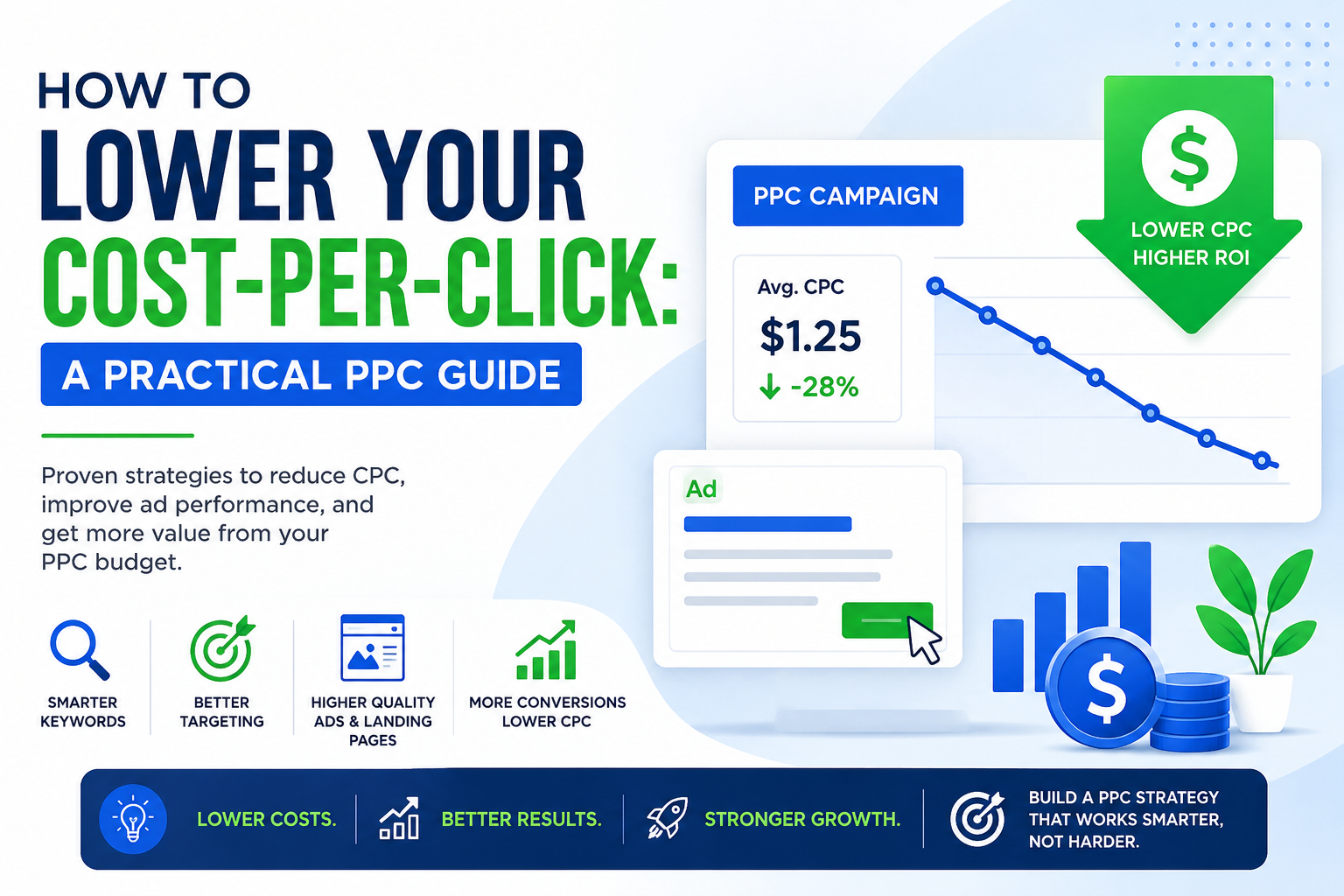
Fortunately, lowering your cost-per-click is not always about increasing your budget or making drastic changes. In many cases, small improvements in strategy, targeting, and campaign management can significantly reduce costs while maintaining or even improving performance.
Understanding how PPC systems evaluate advertisements is often the first step towards improving efficiency and maximising return on investment.
Understanding What Cost-Per-Click Actually Means
Cost-per-click, commonly referred to as CPC, represents the amount an advertiser pays each time someone clicks on an advertisement.
Many business owners assume the highest bidder always wins.
That is not entirely true.
Advertising platforms consider multiple factors, including:
-
Bid amounts
-
Ad relevance
-
Expected click-through rates
-
Landing page quality
-
User experience
This means advertisers can often lower costs by improving quality rather than simply increasing budgets.
Better campaigns frequently outperform larger budgets.
Understanding this principle changes how businesses approach PPC management.
Why High CPCs Often Signal Deeper Problems
When advertising costs rise, many advertisers immediately blame competition.
While competition certainly influences pricing, high CPCs often reveal underlying campaign issues.
Common causes include:
-
Poor keyword targeting
-
Weak advertisement relevance
-
Low click-through rates
-
Ineffective landing pages
-
Broad audience targeting
These problems reduce campaign efficiency.
Advertising platforms reward relevance because they want users to have positive experiences.
The more relevant your campaigns become, the lower your costs can often be.
Efficiency and cost reduction frequently go hand in hand.
Choosing Better Keywords
Keyword selection plays a major role in PPC performance.
Many beginners target broad, highly competitive keywords because they appear attractive.
Unfortunately, these keywords often generate:
-
Higher costs
-
More competition
-
Lower conversion rates
Long-tail keywords frequently provide better value.
For example, someone searching for:
“best accounting software”
may still be researching.
Someone searching for:
“accounting software for small law firms”
usually has a clearer need.
Specific keywords often attract more qualified traffic while reducing advertising costs.
Quality traffic is generally more valuable than large volumes of untargeted visitors.
Improving Advertisement Relevance
Advertising platforms aim to connect users with relevant information.
Advertisements that closely match user intent often receive better performance scores.
Improving relevance may involve:
-
Using targeted messaging
-
Aligning advertisements with search intent
-
Creating focused ad groups
-
Writing clear headlines
The closer an advertisement matches what users are searching for, the better its performance tends to be.
Relevance improves user experience.
Better user experiences often lead to lower CPCs.
The Importance of Click-Through Rate
Click-through rate, commonly known as CTR, is one of the most important PPC metrics.
A strong CTR signals that users find an advertisement relevant and appealing.
Higher click-through rates can contribute to:
-
Better ad positions
-
Improved quality scores
-
Lower advertising costs
-
Greater visibility
Improving CTR often requires testing.
Advertisers may experiment with:
-
Different headlines
-
New descriptions
-
Alternative calls to action
-
Unique selling points
Small improvements in CTR can have a significant impact on overall campaign performance.
Why Landing Pages Matter More Than Many Advertisers Realise
Many businesses focus heavily on advertisements while neglecting landing pages.
This is a mistake.
Advertising platforms evaluate the entire user experience.
A high-quality landing page typically offers:
-
Relevant content
-
Fast loading speeds
-
Clear navigation
-
Mobile responsiveness
-
Useful information
When users find what they expect after clicking an advertisement, campaign quality improves.
Better experiences often lead to lower CPCs and higher conversion rates.
The advertisement and landing page should work together as part of the same journey.
Using Negative Keywords Effectively
Negative keywords are among the most underutilised PPC tools.
They help advertisers prevent ads from appearing for irrelevant searches.
For example, a business selling premium services may wish to exclude searches containing:
-
Free
-
Cheap
-
Tutorial
-
Jobs
Removing irrelevant traffic often improves:
-
Budget efficiency
-
Conversion rates
-
Campaign relevance
Reducing wasted clicks can significantly lower overall advertising costs.
Not every search is worth targeting.
Audience Targeting Can Reduce Waste
One reason campaigns become expensive is poor targeting.
Showing advertisements to people unlikely to convert increases costs without improving results.
Better targeting may involve refining:
-
Geographic locations
-
Demographic groups
-
Device preferences
-
Customer interests
-
Previous website visitors
The more accurately advertisers define their audience, the more efficiently budgets are typically spent.
Precision often outperforms broad exposure.
Continuous Testing Is Essential
Successful PPC campaigns are rarely created once and left untouched.
Performance improves through ongoing testing.
Advertisers regularly test:
-
Headlines
-
Ad copy
-
Landing pages
-
Keywords
-
Bidding strategies
Even small adjustments can produce meaningful improvements over time.
Testing helps identify opportunities that might otherwise remain hidden.
The best campaigns are usually the result of continuous optimisation rather than one-time setup.
Why Quality Score Deserves Attention
Quality Score is one of the most influential factors affecting advertising costs.
Although different platforms use different terminology, the principle remains similar.
Higher quality scores often lead to:
-
Lower CPCs
-
Better visibility
-
Improved performance
Quality scores are typically influenced by:
-
Ad relevance
-
Expected click-through rates
-
Landing page quality
Improving these areas frequently reduces costs while enhancing overall campaign effectiveness.
Advertisers should focus on user experience rather than simply increasing bids.
The Value of Strategic Campaign Management
As campaigns grow, managing them effectively becomes more complex.
Keyword research, audience targeting, performance analysis, bidding adjustments, and optimisation all require time and expertise.
This is one reason businesses often explore dedicated PPC management services when they want to improve campaign efficiency while maintaining focus on their core operations.
Professional management can help identify opportunities for cost reduction while improving overall advertising performance.
Expert oversight often prevents costly mistakes.
Looking Beyond Click Costs
Many advertisers become obsessed with lowering CPC.
While cost reduction is important, it should never come at the expense of business results.
A cheaper click is not necessarily a better click.
The ultimate goal is generating:
-
Leads
-
Sales
-
Appointments
-
Revenue
-
Business growth
Sometimes a higher CPC produces stronger returns because the traffic is more qualified.
Success should be measured by outcomes rather than costs alone.
Profitability matters more than individual metrics.
Smarter PPC Leads to Better Results
Lowering cost-per-click is not about finding shortcuts or manipulating advertising systems. It is about creating better campaigns that provide greater value for both users and advertising platforms.
Businesses that focus on relevance, targeting, landing page quality, audience understanding, and continuous optimisation often achieve lower costs while maintaining strong performance.
The most successful advertisers understand that PPC is not simply about buying traffic.
It is about attracting the right traffic.
When campaigns are built around user needs and business goals, costs become easier to control, budgets become more efficient, and advertising becomes a reliable source of long-term growth.