
Introduction
The manufacturing landscape for complex components like aerospace sensor brackets and medical implants is fraught with challenges. Traditional 3-axis CNC machining often requires multiple setups, leading to cumulative errors exceeding 0.2mm and high production costs. The primary causes are errors from datum shifts between operations, the high cost of specialized fixtures (up to 30% of total costs), and material inconsistencies.
The solution lies in integrating 5-axis combine machining with GD&T engineering. This approach enables single-setup machining, controlling tolerances to within ±0.005mm while reducing costs through process consolidation. The following sections detail how key aspects of 5 axis machining services achieve this dual optimization.
How Does 5-Axis CNC Machining Achieve Precise Control of Complex Geometries Through Single Setup?
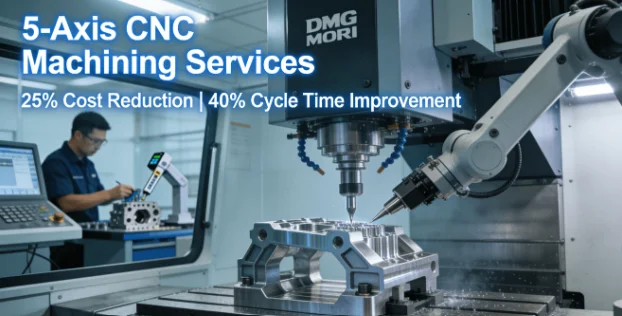
The core advantage of advanced 5 axis machining servicesis the ability to complete complex geometries in one clamping. This eliminates cumulative errors from multiple setups on 3-axis machines. For features like deep cavities and angled holes, simultaneous multi-axis movement allows optimal tool orientation, improving access and ensuring consistent chip load for superior surface finish.
A Society of Manufacturing Engineers (SME) case study demonstrates how this technology reduces datum conversion errors. In 3-axis machining, each new setup introduces potential deviation. Single-setup Precision CNC machining maintains original datums throughout the entire process. A key enabling technology is RTCP (Rotation Tool Center Point), which automatically compensates for tool positional changes as machine axes rotate, ensuring accurate tool tip pathing. In an automotive turbocharger housing project, 5-axis strategies improved dimensional accuracy by 40% and reduced lead time by 50% by consolidating three operations into one.
How Does GD&T Standard Function as an Engineering Language in 5-Axis CNC Machining?
While 5-axis machines provide capability, Geometric Dimensioning and Tolerancing (GD&T) acts as the unambiguous engineering language guaranteeing functionality. Effective 5 axis CNC machining GD&T implementation communicates design intent. Tolerances like position and profile are directly validated through single-setup machining, ensuring features are relationally correct to the datum reference frame.
Compliant with the specifications in ASME Y14.5, a set of principles is established that is inherently logical and consistent with the function of the part and fixturing. By incorporating GD&T calls inside the 3D CAD view in Model-Based Definition (MBD), the process becomes foolproof and error-free, and this is particularly important in the Custom part manufacturing of, for instance, a knee joint prosthesis where the GD&T specification is critical in order to meet the accurate functional specification of articulating surfaces and mounting parts.
How Do Advanced Work Holding Solutions Enhance 5-Axis Machining Efficiency and Cost-Effectiveness?
Optimizing 5-axis machining potential requires workholding that’s just as advanced. Innovative work holding solutions for 5 axes are increasingly crucial to making a process efficient and economically viable, particularly for Rapid Prototyping Solutions.
Economic Benefit of Modular Fixturing
A huge barrier exists: the high cost of a dedicated fixture. With modular systems, having a base plate with reusable clamps and locators, there is a reliable, flexible alternative to dedicated fixtures, greatly reducing fixture costs and changeover times for small-batch production.
Advanced Fixturing for Complex Components
For challenging parts like thin-walled structures, non-traditional methods are essential.
- Electromagnetic and Vacuum Chucks:
These provide uniform holding force, minimizing clamping-induced distortion in thin components.
- Custom Soft Jaws and Mandrels:
Machined from the part CAD model, they offer perfect conformity for secure holding of irregular shapes.
Automation in Work holding
Robotic part loading/unloading systems enhance efficiency by handling part changes during lights-out machining, reducing manual intervention. A satellite bracket batch production project demonstrated that modular fixturing and robotic assistance reduced fixture NRE cost by 60% and per-part cost by 22%.
How Do Material Certification and Full-Process Traceability Ensure the Reliability of 5-Axis Machined Parts?
The accuracy of a machined component will only be as good as the material it consists of. For high-end sectors, material certification and traceability play a critical role for custom 5 axis machined parts.
Compliance with Material Standards
Adherence to specifications such as AMS and ASTM is strictly a matter of chemical composition, properties, and processing history related to materials. It is a guarantee on a fundamental level that all materials are capable of complying with the stringent requirements associated with their intended usage scenarios.
Incoming Material Verification
Each material batch undergoes a rigorous inspection process to verify its integrity before machining begins.
- Chemical Composition Analysis:
Optical emission spectroscopy is used to precisely verify the material’s chemical composition against standard requirements.
- Mechanical Properties Testing:
Destructive and non-destructive tests are conducted on samples to confirm key properties like tensile strength, yield strength, and hardness.
Implementing a Full Traceability Chain
An effective system, based on international quality norms such as ISO 9001 and AS9100D, follows every material from its melt lot number through the entire process until the end product. Companies with more developed systems, like JS Precision, follow such a process as a good example. For a titanium alloy engine part, for instance, such a complete process helped cut down on the percentage of failures by 35%.
How Does an Online Manufacturing Quoting System Optimize Decision-Making Efficiency for 5-Axis Machining Projects?
Speed and transparency in costing are critical. Modern Online manufacturing quote platforms revolutionize decision-making for projects involving 5 axis CNC parts.
These cloud-based systems use algorithms to instantly analyze uploaded 3D CAD models, performing automated DFM analysis. This provides immediate feedback for design optimization. The decision-making speed difference is significant:
| Feature | Traditional Quoting (3-5 days) | Online Instant Quote (2 hours) |
| Response Time | Manual review by engineers | Automated analysis in minutes |
| DFM Feedback | Provided later, if at all | Immediate, integrated with the quote |
| Cost Transparency | Opaque, lump-sum pricing | Itemized breakdown (material, machining, setup) |
| Design Iteration Impact | Slow, requires re-submission | Immediate cost updates with design changes |
For a drone airframe project, instant quotes enabled quick supplier comparison, leading to 15% faster project initiation. Explore the journey of 5 axis CNC parts from design to delivery.
Conclusion
In summary, professional 5 axis machining services represent a paradigm shift. Through the synergy of multi-axis kinematics, GD&T, advanced work holding, material control, and digital tools, this technology delivers unprecedented precision and cost-effectiveness for high-precision manufacturing.
To obtain a customized cost-optimization plan for your next project, contact a professional team for a free GD&T analysis and an instant quote.
Author Biography
The author is a manufacturing engineering specialist with 15 years of experience in precision machining, focusing on process R&D for complex components in the aerospace sector. He has led several international-level technical tackle key problems projects in 5-axis machining.
FAQs
Q1: What is the minimum number of batches required for 5-axis CNC machining?
A: 5-axis machining is applicable to prototypes as well as mass production. Being optimized, it gives cheaper prices to small productions, preferably in quantities of 10 pieces or lower.
Q2: How are the hardness values limited for 5-axis machining?
A: It can also machine materials up to HRC 45. Harder materials require special tools and techniques, for instance, the use of tools coated with Titanium Aluminum Nitride (TiAlN) for cutting titanium alloys.
Q3: Is software assistance required for GD&T annotation?
A: Yes, this will require 3D CAD software capable of working with PMI (Product and Manufacturing Information), like SolidWorks or Siemens NX. The suppliers should convey the guidelines for annotations.
Q4: What is the achievable surface roughness in complex surface machining?
A: To what extent can a surface roughness Ra ≤ 0.8μm for aluminum or Ra ≤ 1.6μm for titanium alloy be achieved by trochoidal milling processes? Polishing can also be used if needed.
Q5: How does the online quoting system ensure accuracy?
A: The system integrates DFM analysis modules that automatically identify the manufacturability of part features and optimizes parameter recommendations based on historical machining data.